You are visiting the Canada Kee Safety website from United States. Would you like to go to the United States site?
You are visiting the Canada Kee Safety website from United States. Would you like to go to the United States site?

Workplace falls accounted for nearly 62,000 lost time claims in 2024, including falls on the same level. Although working at height is a hazard in any commercial, institutional, or industrial facility, effective fall protection also entails understanding how workers move throughout the building.
Maintenance teams access large equipment, contend with elevation changes, and cross over obstacles. They go from working in confined areas to competing with forklifts to navigate open floor space. And the challenges vary from site to site.

For businesses focused on workplace safety in Canada, investing in engineered access systems enables them to address fall risks at the source. It starts with understanding how workers move through a facility and how the workplace access systems function. Instead of after-the-fact mitigation, they can enhance employee safety, improve efficiency, and bolster long-term operational reliability.
Here are 9 practical ways to provide safe access solutions and reduce fall risk in commercial, institutional, and industrial facilities.

Workers often need to reach machinery, conveyors, tanks, rooftop equipment, and other elevated areas to perform inspections, maintenance, and repairs. Purpose-built elevated work platforms provide stable, guarded working surfaces designed for the task at hand. They feature anti-slip aluminum or glass-reinforced nylon step and deck treads set in robust, durable, corrosion-resistant frames with integrated guardrails.
From manufacturing facilities and warehouses to healthcare operations and educational institutions, access platforms are safer and more efficient than ladders or improvised scaffolds. Workers do not need to haul tools and maintenance equipment while balancing themselves as they climb.

Buildings often require regular rooftop access to service HVAC units, exhaust systems, communication equipment, solar arrays, and other building services systems. Roof hatches are commonly used for roof ingress and egress, but they also introduce significant risk during the transition between the ladder and roof surface.
Roof hatch safety railings surround the opening, forming a compliant guardrail system that clamps to the hatch to prevent penetration of the roof membrane. They also feature a grab bar to assist workers when entering or exiting the roof.

Precipitation, debris, fragile surfaces, and elevation changes make the roof’s surface itself a fall hazard for maintenance workers who must navigate their way to HVAC units and other equipment.
Rooftop walkway systems create designated, slip-resistant travel routes that guide workers safely across the roof to the equipment they need to service. By keeping foot traffic on a defined path, these systems reduce exposure to unstable or unprotected areas and help protect roofing materials from unnecessary wear. They feature self-draining treads to prevent the accumulation of rain, snow, or ice and can be angled up to 35% to handle elevation changes.

Rooftops can be cluttered with pipes, ductwork, conduits, cables, and structural supports that pose trip hazards. Maintenance technicians should not be expected to hop over or scale these obstructions, especially when carrying tools.
Crossover platforms allow workers to step up and over obstacles as well as bridge a change in the roof level or a hazardous gap. They feature anti-slip walkway treads and integrated guardrails for safer, more cohesive workplace access design.

Unprotected roof perimeters are perhaps the most significant fall hazard in any facility.
Freestanding industrial guardrail systems installed around roof edges provide continuous, passive protection without requiring workers to don personal fall-arrest equipment. These modular systems are adaptable to virtually any flat or low-sloped roof and protect restricted access points. They feature robust aluminum or galvanized steel construction with recycled PVC counterweight bases that do not penetrate the roof membrane.

Although the rooftop poses several hazards, everyday fall risks—mezzanines, loading docks, equipment pits, stairways—proliferate throughout a typical facility. Ground-based guardrails provide reliable physical barriers that keep workers from inadvertently entering dangerous areas, establishing clear boundaries around hazards. They reduce the chance of accidental falls and unauthorized access.
For strength, durability, and reliable fall protection, anodized aluminum and hot-dipped galvanized steel guardrails are the ideal choices for commercial, institutional, and industrial settings. Both are corrosion-resistant; however, aluminum is recommended for harsher chemical or marine environments.
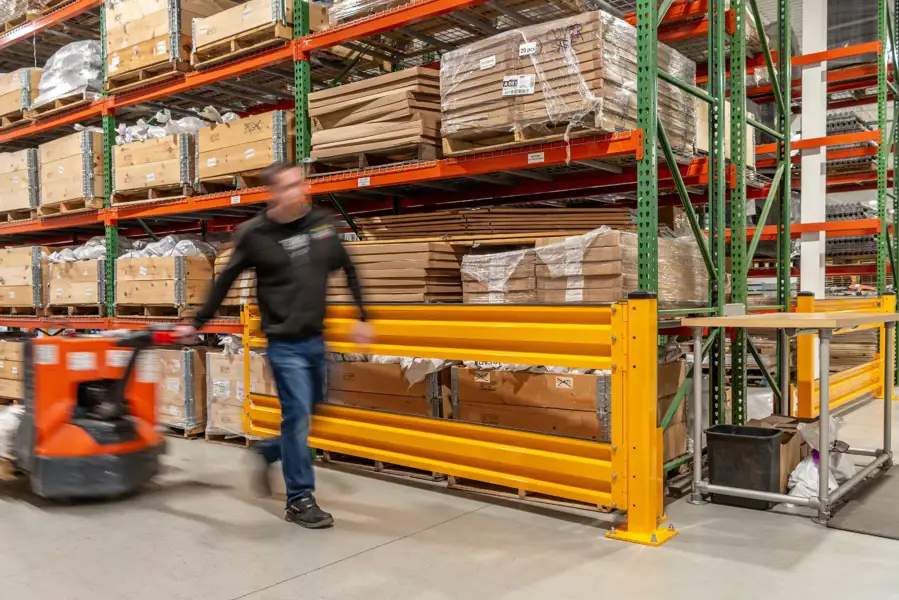
Worker and pedestrian traffic can become hazardous when pathways are poorly defined, obstructed, or overlap with forklift routes. Dedicated pedestrian safety systems separate foot traffic from vehicles and other operational hazards, giving workers a clear, marked route to follow throughout the facility.
Traffic barrier guardrails create unequivocal workplace safety barriers that improve overall facility organization and make it easier for new employees, contractors, and visitors to navigate the site safely.

Transition points on elevated work platforms, roof hatches, mezzanine stairs, loading dock openings, pedestrian guardrail systems, and other areas with safe access equipment need constant safeguarding because workers pass through them so often.
Self-closing safety gates provide continuous safeguarding by automatically closing and latching behind a worker. Since they protect the opening without impeding workflow, safety gates are valuable workplace safety improvements at high-traffic transition points. Constructed of aluminum or galvanized steel, they integrate seamlessly into modular guardrail systems.

Safe access should be available to everyone who needs it, including individuals using a wheelchair or another mobility aide. Elevation changes at entrances, walkways, and work areas can create access and safety challenges, especially for workers moving equipment or materials on carts, dollies, and hand trucks.
Accessibility ramps offer slip-resistant, gradual transitions between elevations and feature a modular design that adapts to virtually any entrance or transition point. They help create more inclusive, durable access routes that support long-term reliability and easier movement throughout a facility.

Kee Safety: Your Fall Protection Experts
Kee Safety is the world’s leading fall protection expert. We engineer, manufacture and install fall protection solutions that safely separate people from hazards. Our OH&S-compliant products and systems are third-party tested and trusted to ensure consistent performance at the highest level.