You are visiting the Canada Kee Safety website from United States. Would you like to go to the United States site?
You are visiting the Canada Kee Safety website from United States. Would you like to go to the United States site?

“Let’s eat, Grandma!” vs “Let’s eat Grandma!” shows how the active voice of punctuation saves lives, while its passive omission has consequences.
For owners and facility managers responsible for work at height safety, choosing the right approach to fall protection systems in Canada starts with understanding two core methodologies: active and passive fall protection.
Unlike the passive situation with Grandma (probably the wolf in “Little Red Riding Hood”), each plays a distinct role in reducing risk and saving lives, supporting fall protection compliance in Canada. The most effective solution depends on how your facility is accessed, how work is performed, and how much reliance you want to place on human behavior.

Passive fall protection systems are designed to prevent a fall from occurring in the first place—without requiring any action from the worker. There is no need to inspect and wear specialized Personal Protective Equipment (PPE), and no certified training is required. Once installed, passive systems are always in place and always protecting workers.
Active fall protection systems, often referred to as a fall arrest system, require workers to take deliberate action by connecting PPE to a lifeline and a certified anchor. These systems do not prevent the fall but instead arrest it after it occurs, minimizing the risk of injury. Active systems are highly effective when properly designed and used—but they rely on training, inspection, and consistent worker compliance.
Since passive systems do not depend on training, harness use, or conscious decision-making, they are considered the highest level of protection and are especially effective where multiple workers or contractors access a roof or other elevated areas regularly.

Constructed of strong, durable, corrosion-resistant aluminum or galvanized steel, guardrails provide versatile fall protection at entrances, loading docks, staircases, mezzanines, catwalks, elevated work platforms, catwalks, workstations for large equipment, open edges, along pedestrian paths, and for a wide range of rooftop fall protection (e.g., roof perimeters, hatches, skylights, fixed ladders). They install without welding or drilling and can be reconfigured if the facility needs or layout changes.

Featuring a spring-loaded mechanism that closes and latches as soon as the worker passes through, self-closing gates safeguard openings at critical access points, such as staircases, elevated work platforms, and roof hatch kits. Available in aluminum or galvanized steel in single-width, double-width, and double-height models, they integrate seamlessly into guardrail systems or the building’s structure.

Built with aluminum or glass-reinforced nylon treads set in sturdy, stable aluminum or galvanized steel frames, roof walkway systems delineate safe travel paths across rooftops. The treads are anti-slip and self-draining, avoiding the accumulation of rain, snow, or ice. They safeguard workers and protect the roof from repeated foot traffic.
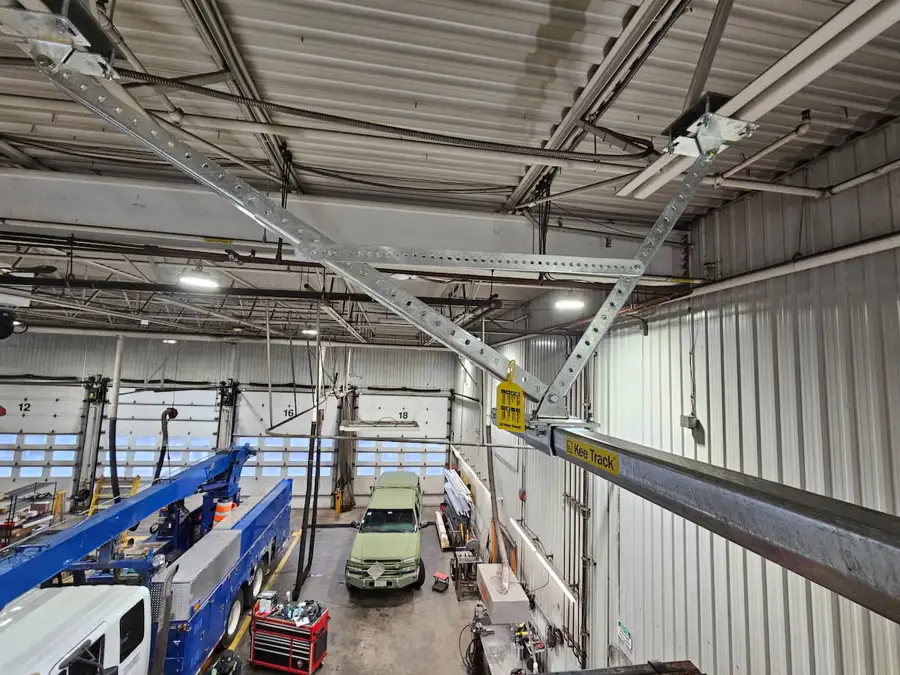
A track-and-trolley system with a self-retracting lifeline, modular rigid rail systems enable workers to perform tasks with continuous tie-off from overhead, such as vehicle and machinery maintenance, and loading and unloading. They are easy to install and reposition, and particularly effective when users work at short free-fall distances.

Featuring galvanized and stainless steel components, horizontal lifeline systems provide continuous tie-off and compliant fall arrest along rooftops and other elevated workspaces. Up to three workers can be accommodated within 11.9-meter (39-ft.) spans between anchorages.

Anchor points are the backbone of any lifeline system and must withstand a 5000 lbs. (22.2 kN) load without permanent deformation. Applications include tieback anchors for window washing and façade maintenance, a single-point anchor for tie-off with a lanyard or retractable lifeline, and a brace for pairing with a horizontal lifeline system.
The type of work being performed, frequency of access, user behaviour, and regulatory requirements all need to be considered when selecting fall protection systems.

Flat or low-sloped roofs that require frequent access for HVAC maintenance, inspections, or snow removal benefit most from passive systems, which provide uninterrupted protection. In contrast, infrequent or short-duration tasks may justify the use of active fall protection systems. Window washing and façade maintenance on taller buildings also use active fall protection.
Passive systems significantly reduce the risk of human error. Active systems demand a strong safety culture, certified training, and enforcement to ensure workers inspect their equipment and are properly tied off at all times.

A clear roof perimeter is easily protected with guardrails. Congested rooftops with equipment, skylights, or changing work zones may require engineered fall protection products, such as a horizontal lifeline to provide flexibility and mobility.
Both active and passive systems can meet Canadian OHS requirements when professionally designed and installed. However, regulations prioritize hazard elimination and collective protection wherever feasible, often favoring passive solutions. Critical regulations to follow include the Canada Occupational Health and Safety Regulations (SOR/86-304) for guardrails and active fall protection equipment.
In practice, many facilities adopt a hybrid strategy. Passive roof fall protection—railings, walkways, and gates—protects common access areas, while active systems are used for specialized or irregular tasks. This integrated approach delivers reliable protection while minimizing reliance on perfect human behaviour.
Ultimately, the best system is one that aligns safety, compliance, and operational efficiency—keeping workers protected and productive, while ensuring everyone goes home safely at the end of the day to enjoy a fine dinner WITH Grandma.
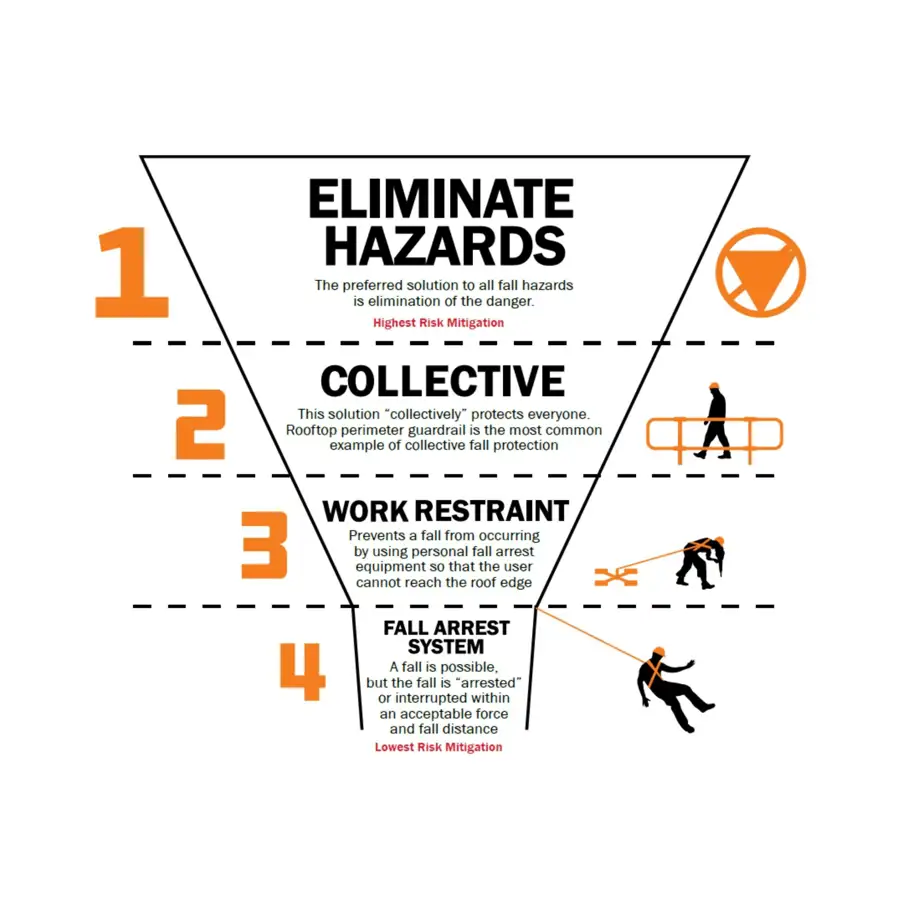
A truly comprehensive rooftop solution follows the Hierarchy of Fall Protection. An expert starts by inspecting the roof site for potential fall hazards. From there, a complete system solution and recommendations are created that descend down the four levels of the hierarchy, from simple, sensible approaches for eliminating risks all the way down to lifesaving personal protection systems.
Collective Systems require no additional training to use. Fall Restraint and Fall Arrest Systems both require a high level of user competency, training and additional inspection to be used properly.