You are visiting the Canada Kee Safety website from United States. Would you like to go to the United States site?
You are visiting the Canada Kee Safety website from United States. Would you like to go to the United States site?

A person wandering onto a rooftop—say, in the movies—should be wary of the perils, such as being abducted by aliens, caught in the middle of a seagull uprising, or menaced by a malcontent gargoyle springing to life.
A maintenance worker accessing a commercial, institutional, or industrial rooftop faces a host of real-life hazards, though all are manageable with the right rooftop safety systems in place.
HVAC unit and solar array servicing, equipment inspections, roof repairs, and routine maintenance all require workers to navigate environments where a simple misstep can cause a serious or fatal fall. Identifying work-at-height hazards and addressing them with engineered controls protects workers, ensures compliance, and keeps operations running smoothly.

Roof hatches, ladder access points, and stairwell openings create unprotected gaps that workers can fall through during entry, exit, or while moving tools and equipment. The risk increases in poor weather or low visibility.
Effective roof access safety should be built around a self-closing safety gate. They feature an internal spring-loaded mechanism that automatically closes and latches after the worker passes through. The gates can be installed at the top of a stairwell entrance to the roof and are an integral component of compliant fall protection for workers accessing the roof via hatches and fixed ladders.

Skylights, roof lights, smoke vents, and other openings are among the most deceptive hazards on rooftops. Many appear capable of supporting a person’s weight but cannot hold up under pedestrian traffic or impact loads. A worker who steps onto one can fall straight through.
Rooftop openings protection for skylights can be achieved with two types of compliant systems that eliminate the risk of falling through without blocking the sunlight or hindering ventilation:

Modern rooftops have an increasing number of building services systems, with supporting piping, conduits, cable trays, ductwork, and other equipment. Although essential, they create a variety of rooftop trip hazards—compounded by winter weather and slippery conditions.
Engineered walkway systems feature anti-slip, self-draining treads to create safe, stable pathways to traverse crowded rooftops.

The edge is the most serious hazard on any rooftop. Even an experienced worker performing a routine inspection near the perimeter can face a significant fall with a single misstep.
Passive fall protection should be the first choice whenever possible. These systems place a barrier between the worker and the hazard, relieving the worker of the need to wear special equipment.
On the federal level, rooftop safety solutions in Canada are guided by the Canadian Centre for Occupational Health & Safety. Provinces and territories have their own requirements, such as the Ontario Occupational Health & Safety Act.
It is clear from these requirements that no specific product or system addresses every rooftop risk. The most effective strategy combines multiple layers of protection tailored to a building’s specific hazards. Organizations must evaluate access points, openings, travel paths, maintenance areas, and perimeter edges, and then apply the appropriate engineered controls—passive and active—to safeguard workers.
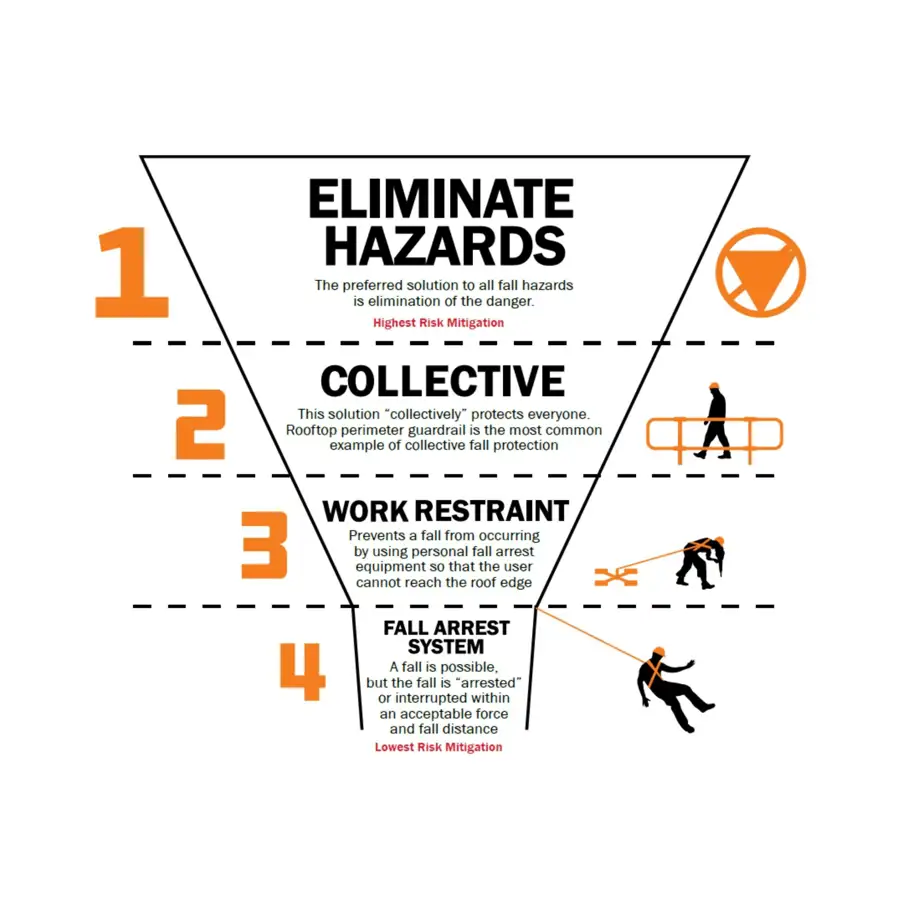
A truly comprehensive rooftop solution follows the Hierarchy of Fall Protection. An expert starts by inspecting the roof site for potential fall hazards. From there, a complete system solution and recommendations are created that descend down the four levels of the hierarchy, from simple, sensible approaches for eliminating risks all the way down to lifesaving personal protection systems.
Collective Systems require no additional training to use. Fall Restraint and Fall Arrest Systems both require a high level of user competency, training and additional inspection to be used properly.