You are visiting the Canada Kee Safety website from United States. Would you like to go to the United States site?
You are visiting the Canada Kee Safety website from United States. Would you like to go to the United States site?

A live theater performance usually comes off flawlessly, but behind the scenes it is choreographed chaos. The stage manager is frantic with instructions. The lighting and sound crews must follow the action with precision. Scene shifts and costume changes are carried out in a flash.
Modern healthcare facilities are major productions of patient care, with mobile hospital beds, diagnostic and treatment equipment, ancillary services, and medical staff providers taking center stage.
But behind the scenes, notably on the rooftop, facility managers face an equally critical challenge of keeping building support services running reliably and efficiently. If the HVAC units, air-handling systems, exhaust fans, backup generators, and telecommunications equipment are not fully operational 24/7, the quality of patient care is at risk.
This calls for regular inspections and maintenance of support systems. From the ground-level entrances to the rooftops, hospitals, medical centres, long-term care facilities, and healthcare campuses must be designed with a healthcare facility fall protection plan that safeguards maintenance crews and contractors, enhances regulatory compliance, and supports uninterrupted operations.


Safe access begins before workers ever reach the roof. Healthcare facilities must accommodate patients, visitors, vendors, and employees with a wide range of mobility needs. Accessible entrances are a core part of that responsibility.
Modular Accessibility Ramps provide access solutions compliant with the Accessible Canada Act to accommodate people using wheelchairs, walkers, and other mobility aids. Featuring anti-slip surfaces, “warm-to-touch” PVC handrail tubing, and corrosion-resistant components, they can be installed within hours using simple hand tools. A variety of configurations are available, including integrated steps and gates to adapt to virtually any entrance layout.
Ground-Level Hazards During Facade & Building Maintenance
Maintenance personnel also need safe routes to building systems, utility areas, loading docks, and service entrances. For interior and exterior applications, anodized aluminum or hot-dipped galvanized modular railing systems are strong, durable, and corrosion-resistant. They are easily installed without welding or drilling and can be expanded or reconfigured as facility layouts and needs change.

Routine inspections and maintenance activities often require workers and contractors to access rooftops, creating significant work-at-height risks.
Unsafe Roof Access & Transitions
Common hospital rooftop hazards occur where workers transition from ladders, roof hatches, or stair access points onto the roof surface. This exposes them to falls during entry and exit.
Many healthcare facilities have extensive flat roof areas with mechanical equipment positioned near perimeter edges. Workers performing healthcare roof inspections and maintenance need the highest level of fall protection.
Rooftop safety systems for healthcare facilities must consider sprawling roof systems that require maintenance personnel to walk lengthy distances between access points and equipment. Without designated routes, workers may cross uneven surfaces, wander near leading edges, or slip on snow, ice, or rainwater.

Healthcare rooftops frequently contain dense networks of piping, conduits, ductwork, and cable trays. These obstacles create significant trip hazards, particularly in poor weather or during emergency repairs.

Not every rooftop fall hazard is protected by guardrails. Certain maintenance tasks require workers to approach unprotected edges or elevated equipment where barrier systems are impractical. Healthcare facility fall protection should then follow the hierarchy of controls, implementing personal protective equipment (PPE).
Healthcare facilities may require façade maintenance, window cleaning, and exterior repairs that cannot be completed from the roof surface alone. Fall arrest systems, allowing workers access from above, can be deployed for these specialized tasks and provide healthcare maintenance safety.
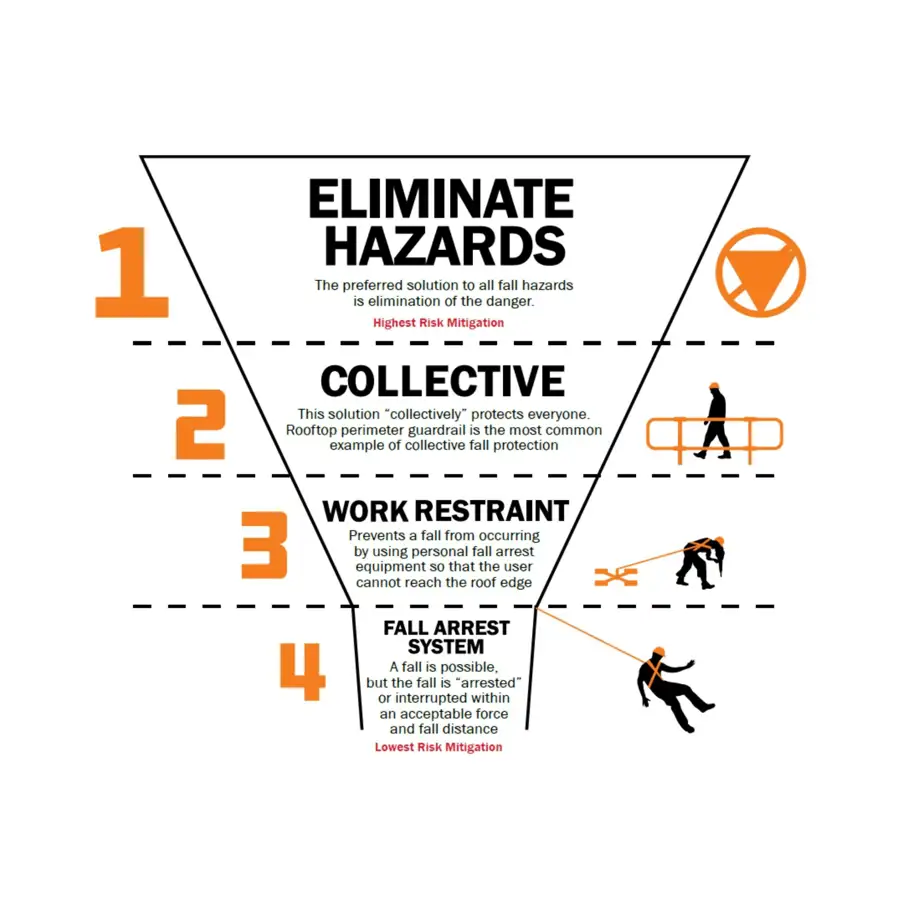
A truly comprehensive rooftop solution follows the Hierarchy of Fall Protection. An expert starts by inspecting the roof site for potential fall hazards. From there, a complete system solution and recommendations are created that descend down the four levels of the hierarchy, from simple, sensible approaches for eliminating risks all the way down to lifesaving personal protection systems.
Collective Systems require no additional training to use. Fall Restraint and Fall Arrest Systems both require a high level of user competency, training and additional inspection to be used properly.