You are visiting the Canada Kee Safety website from United States. Would you like to go to the United States site?
You are visiting the Canada Kee Safety website from United States. Would you like to go to the United States site?

From the underground to the end user, the oil and gas industry in Canada integrates upstream, midstream, and downstream operations, all contributing to making Canada the fourth-largest oil producer in the world.
And from Alberta’s upgrader plants to coastal LNG terminals, workers routinely work at significant heights on refineries, tank farms, pipe racks, and rooftops. Since the risk of falling is one of the industry’s most persistent dangers, effective fall protection system design should also integrate across all processes.
This engineering imperative must align with jurisdictional safety regulations and be based on hazard assessments that identify where passive barriers are appropriate or where active fall-arrest systems are necessary.

Successful fall protection strategies begin before a worker climbs the first ladder. With a structured hazard assessment, engineers identify every elevated work area, the frequency with which workers will access it, and the nature of the tasks performed there.
They pose questions, such as, “How do workers move across the facility? Are they carrying tools, sampling equipment, or tablets? Do they need to cross pipe racks daily?” By embedding safety into the initial layout of new facilities or major retrofits, engineers can eliminate many hazards outright.
For example, in Alberta oil and gas safety, this means designing platforms with built-in guardrails, specifying permanent walkways on storage tanks, and ensuring all elevated work areas have sufficient clearance for anchorage connectors. Retrofitting after construction is typically more expensive and can be less effective.

Canadian oil and gas facilities face difficult challenges. Snow accumulation can hide trip hazards. Ice can compromise slip resistance. High winds can increase the chance of falls.
Fall protection hardware must be rated for sub-zero temperatures, and structural anchor points must be engineered to account for increased loads from snow and ice. CSA-compliant fall protection systems undergo rigorous testing for these conditions, ensuring anchorage points maintain strength at -40°C.
Aluminum, stainless, and hot-dipped galvanized steel components resist corrosion in freeze-thaw environments where exposure to chemicals is common.
An elemental decision in industrial safety design is choosing between passive and active fall protection systems.
Passive systems are barriers placed between the hazard and the work area. They are preferred because they can protect multiple workers simultaneously without direct involvement or specialized training. Examples include:
Modular Guardrail Systems
Constructed of anodized aluminum or galvanized steel for strength, durability, and corrosion resistance, these pipe-fitted systems are ideal for pump stations, mezzanines, compressor decks, high-traffic pedestrian corridors, and other areas to separate people from hazards.
Non-Penetrating Roof Guardrails
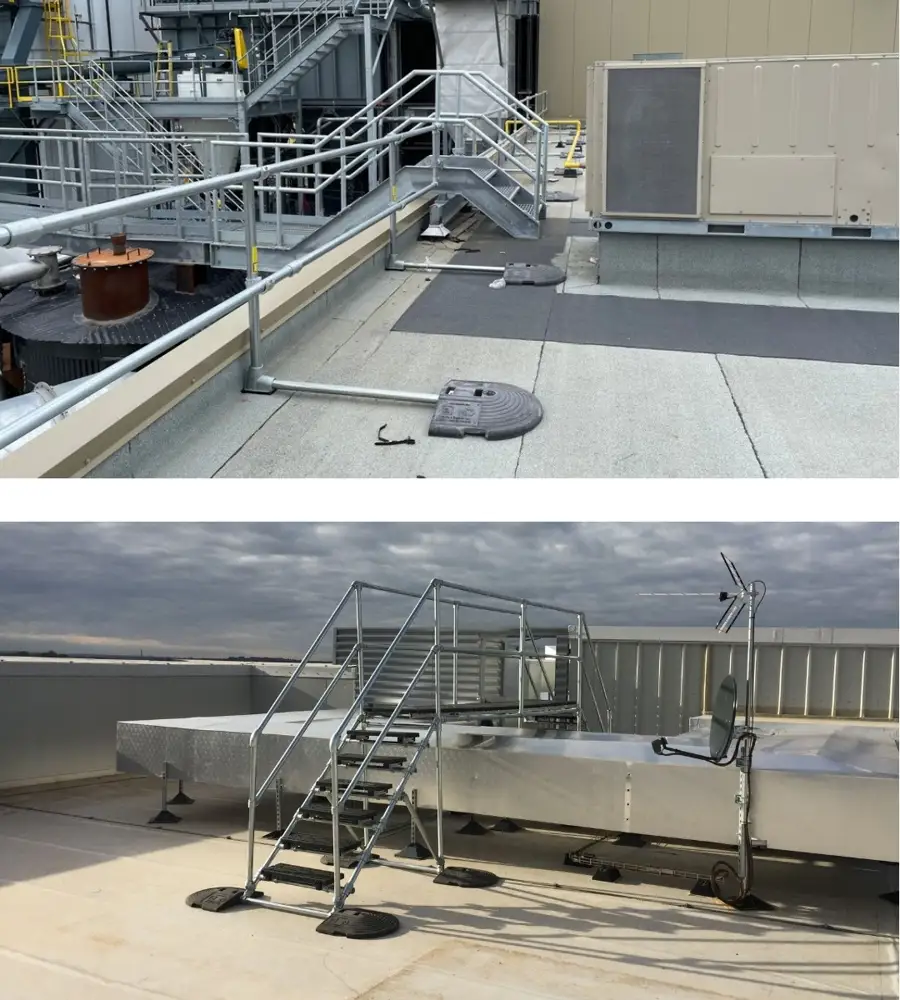
For the tops of tank farms, storage vessels, refinery towers, and process rooftops, freestanding guardrails are rooftop safety systems that feature counterweight bases for flat and low-sloped roofs, or clamp-on bases for metal profile roofs. They are installed without welding, drilling, or penetrating the surface below.

Modular Work Platforms
Designed for refinery towers, elevated processing units, and other equipment access maintenance needs, these platforms feature anti-slip steps and decking stabilized by pipe-fitted frames and integrated guardrails. Styles include:
Where guardrails and other barriers are not practical or already in place, active systems, such as horizontal lifelines and personal fall arrest equipment, are required. They enable workers to move freely across expansive roofs on upgrader plants and refineries, tank-top surfaces, and elevated walkways. Featuring stainless steel cables, they can protect multiple workers with continuous tie-off between anchorages.
All engineered fall protection systems deployed in Canadian oil and gas facilities must comply with CSA Z259 series standards, which govern a broad spectrum of attributes from anchorage components to connecting hardware and energy absorbers.
Regulations for oil and gas safety in Canada require that fall protection systems be designed, installed, and inspected by qualified persons. Engaging a safety engineering firm or a manufacturer’s technical team during the design phase ensures that product selection, engineering, and worker movement patterns are considered as an integrated system rather than isolated components.

In the high-stakes world of oil and gas, safety is paramount. Our innovative safety solutions are designed to protect your workforce, assets, and the environment, ensuring your operations run smoothly and efficiently. Keep you team safe from hazards.