You are visiting the Canada Kee Safety website from United States. Would you like to go to the United States site?
You are visiting the Canada Kee Safety website from United States. Would you like to go to the United States site?

Reviewed by Kevin Dong, RHFAC Professional, Accessibility Consultant at Kee Safety Canada
For Canadian facility owners, property managers, and operations teams, ensuring barrier-free access for commercial buildings is not only a legal necessity. It is an ethical imperative and a best practice for business. Whether you manage a retail store, office tower, shopping mall, or industrial building, inaccessible design excludes a sizable portion of the population.
Installing commercial ramp systems in Canada and accessible handrail systems—and consulting with accessibility experts—will help organizations resolve common accessibility barriers and comply with the Accessibility for Ontarians with Disabilities Act (AODA) and the National Building Code of Canada (NBC).


Commercial accessibility in Canada is governed by various federal, provincial, and municipal rules. On the national level, the Accessible Canada Act (ACA) sets requirements for employment, the built environment, and several other areas. Its goal is to make Canada barrier-free by January 1, 2040.
Other provinces have similar legislation. Ontario passed the AODA in 2005 to take full effect by January 1, 2025, a deadline already reached. Furthermore, all commercial construction must comply with applicable building codes — including the NBC and provincial equivalents — which include mandatory barrier-free design requirements.
AODA accessibility requirements mandate that organizations remove barriers to access across their physical spaces. For facility owners, this includes accessible entrances, accessible routes throughout the building, compliant ramp systems, proper handrails, and signage. Non-compliance can result in significant penalties, but more importantly, inaccessible facilities exclude a large segment of the Canadian population, notably seniors and individuals with mobility, vision, or cognitive disabilities.
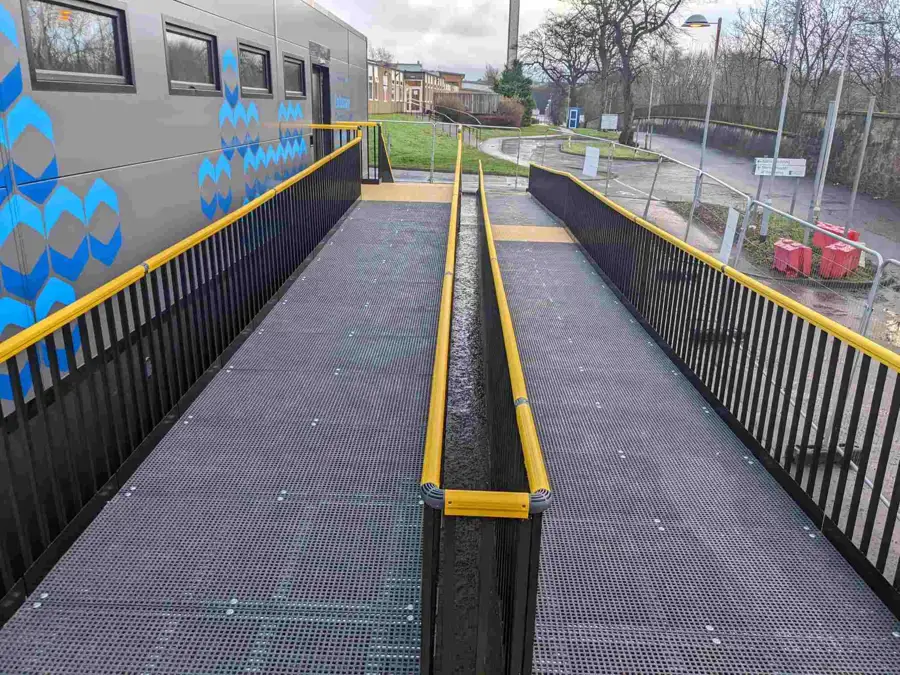
Accessibility is more than meeting minimum building code requirements. Meaningful access focuses on how people actually experience and use a space in real-world conditions.
For example, a ramp may technically comply with code requirements, but if it is difficult to locate, uncomfortable to use, or disconnected from the main entrance flow, it may still create barriers for users.
Meaningful access considers usability, independence, safety, and dignity for people with different mobility and accessibility needs. This approach helps organizations move beyond basic compliance and create commercial environments that are truly inclusive and functional for employees, customers, and visitors.
Accessibility for commercial facilities is more than compliance. It must address building spaces so that every visitor, employee, and customer can participate fully. The most frequently identified accessibility gaps in commercial facilities include:


An accessible building entrance in Canadian facilities is a visual commitment to compliance that sets the tone for every visitor’s experience. For your building, ask yourself, “Can a wheelchair user approach, enter, and exit independently?” If not, this is your highest-priority fix. Ensure the entry is level or has a ramp, is clearly identified, and features an automatic or low-resistance door.
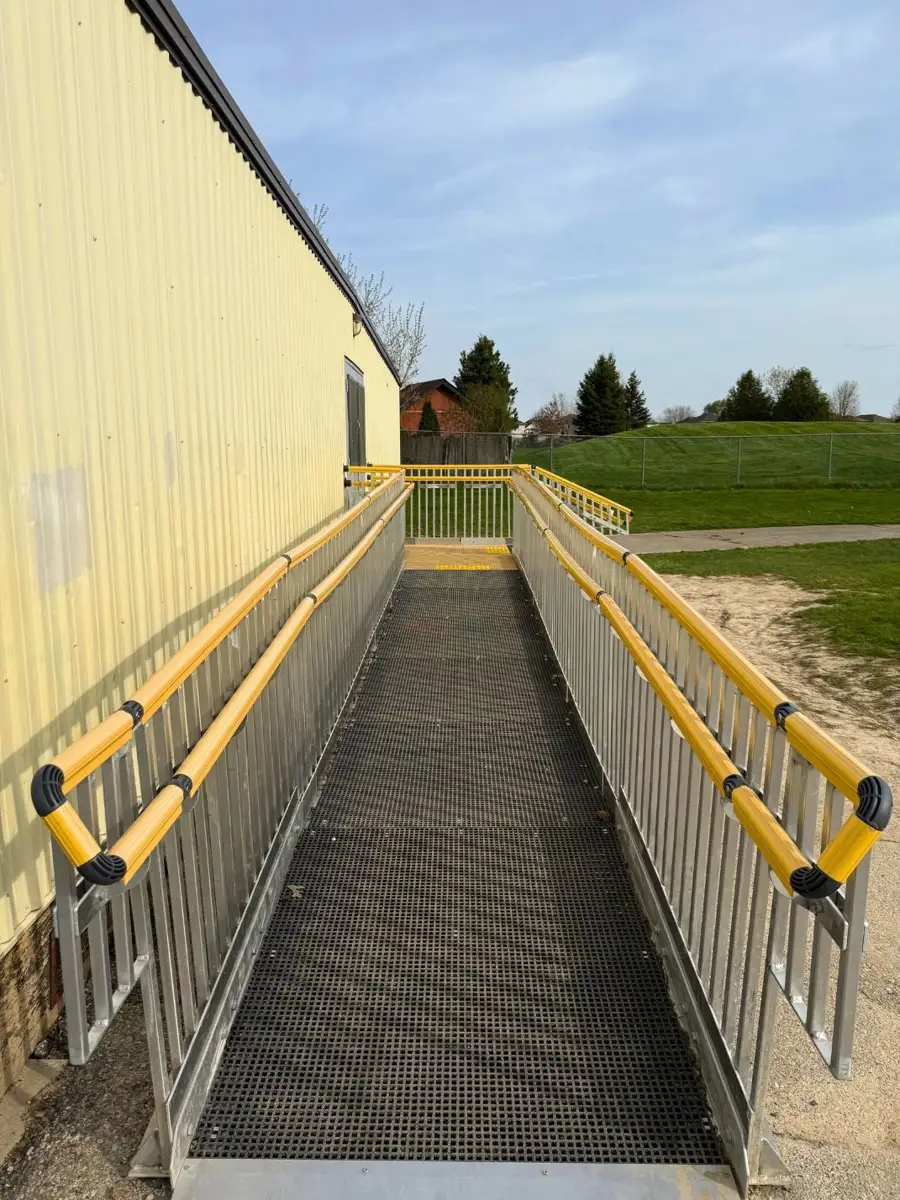
Where steps exist, commercial ramp systems provide the solution. Permanent concrete ramps can be costly and disruptive to install. Modular accessibility ramps are prefabricated systems that install quickly and easily. They feature:

Handrails are a critical element of accessible design. Canadian building codes and AODA standards specify handrail heights between 34 and 38 inches (860 mm to 965 mm) above the ramp or stair surface. Handrails must also be “smooth” so they can be grasped continuously and include extensions beyond the top and bottom of any ramp or stair. Compliant handrails must be on both sides of an accessibility ramp.
For new construction or retrofit, Kee Klamp access railing offers a compliant, flexible solution. Featuring a modular design, they can adapt to odd angles or unusual building geometries. Constructed of hot-dipped galvanized steel for strength, durability, and corrosion-resistance, they are easily assembled and modified on-site with standard tools. No welding or drilling is needed. In addition to being ideal for outdoor venues, they can be installed throughout the facility.

Self-assessments are an important first step, but they can easily miss issues that go beyond ramps and railings. A thorough accessibility audit requires trained expertise. Certified Rick Hansen Foundation Accessibility Certification (RHFAC) professionals are trained to assess commercial buildings against a comprehensive set of criteria that go well beyond basic code compliance — evaluating the full experience for people with a range of disabilities.
Kee Safety now offers dedicated Accessibility Consulting for Canada. Led by Kevin Dong, a certified RHFAC Professional, a systematic on-site assessment identifies accessibility gaps across your facility—inside/out—and develops a prioritized, actionable improvement plan tailored to your building’s specific conditions. The goal is to provide meaning full access providing road map reducing liability and deliver a better experience for all users.

Our Accessibility Consulting Service helps you identify barriers, improve access, and meet Canadian accessibility standards. Led by our Accessibility Sales Manager, Kevin Dong, a certified RHFAC professional, we provide clear, actionable recommendations to create safer, more inclusive spaces.