You are visiting the Canada Kee Safety website from United States. Would you like to go to the United States site?
You are visiting the Canada Kee Safety website from United States. Would you like to go to the United States site?

In the seminal John Le Carré Cold War novel of 1963, “The Spy Who Came in from the Cold,” British intelligence officer Alec Leamas returns to London after a difficult assignment in West Berlin, presumably for retirement or a more sedate mission. “Coming in from the cold” in spy jargon. It did not turn out that way, as Leamas is sent undercover to East Germany, where he…(sorry, no spoilers here).
For maintenance technicians, winter tasks indoors may seem like they are coming in from the cold with its hazards of icy walkways, snow-loaded roofs, and wind chill factors. In reality, winter is a busy and risky season inside commercial, institutional, and industrial facilities. Freeze-thaw cycles expose roof leaks, tracked-in moisture accelerates corrosion, and heating systems run at peak demand.
These conditions drive a surge in indoor repairs and upgrades, shifting risk from the exterior to the factory floor, warehouse, or plant interior. The challenge is not temperature, but a sharp increase in fall hazards created by temporary access, elevated work, and rushed repairs.

Winter facility maintenance frequently requires working at height in areas never intended for routine access. Servicing overhead lighting, repairing interior roof structures, installing ductwork, or modifying conveyors often places workers near leading edges, mezzanines, and open floor pits. Ladders and temporary scaffolds are not necessarily the safest and most efficient way to access elevated areas.
Indoor conditions can also deteriorate in winter. Condensation from temperature differentials creates slick surfaces. Melted snow is tracked inside, reducing traction on smooth floors. Tools, hoses, and materials crowd work zones, while contractors may be unfamiliar with facility layouts. Even in climate-controlled spaces, these factors significantly increase exposure to slips, trips, and falls—making indoor fall protection a critical element of any winter safety plan.
Rushed repairs often lead to improvised solutions, but administrative controls like signs and instructions to “work carefully” are not enough. The most effective winter safety strategies rely on engineered protection that does not depend on constant worker vigilance.
A. Modular Guardrail Systems
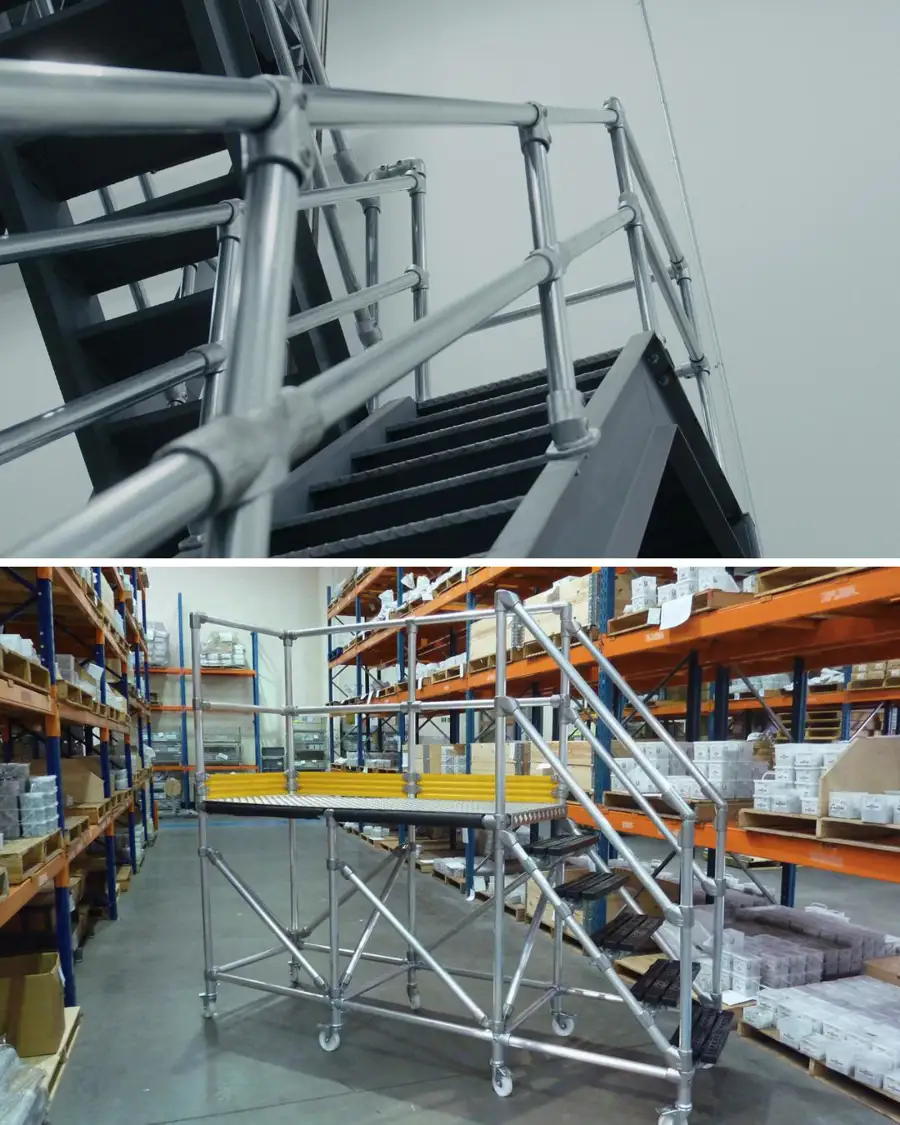
Modular guardrail systems provide immediate, passive (always in place) protection around edges, openings, and elevated work areas. They are easy to install—no welding or drilling needed—and can be reconfigured as seasons or facility needs change. These adaptable, corrosion-resistant safety barriers secure mezzanines and loading docks, line walkways, or delineate safe pedestrian paths.
B. Work Access Platforms
Where tasks require frequent access at height, work platforms are a safer and more efficient alternative to ladders and temporary scaffolds. They feature stable, slip-resistant surfaces with self-draining treads to prevent the accumulation of fluids or moisture. Integrated guardrails and toe boards further reduce both fall risk and task time during winter maintenance windows.

C. Safety Gates
For controlled access at mezzanines, loading docks, ladder openings, stairs, work platforms, and other areas, safety gates are essential. Built from aluminum or galvanized steel, they integrate seamlessly with guardrail systems or the building structure.
D. Traffic Safety Barriers
Indoor winter maintenance rarely happens in empty buildings. Production continues, forklifts move materials, and pedestrian traffic flows around active work zones. These intersections between people, machinery, and inventory with moving vehicles create multiple hazards. Traffic safety barriers establish a physical buffer to protect human and material resources.
Effective winter safety planning must also include the great indoors. Facility managers should identify areas where access is repeatedly needed during winter and evaluate engineered alternatives, such as guardrails, work platforms, safety gates, and traffic shields.
Winter may push more work indoors, but it does not reduce hazards—it redistributes them. By treating indoor hazards as permanent risks and deploying flexible, engineered solutions, organizations can complete winter repairs and upgrades efficiently while keeping workers protected throughout the season.